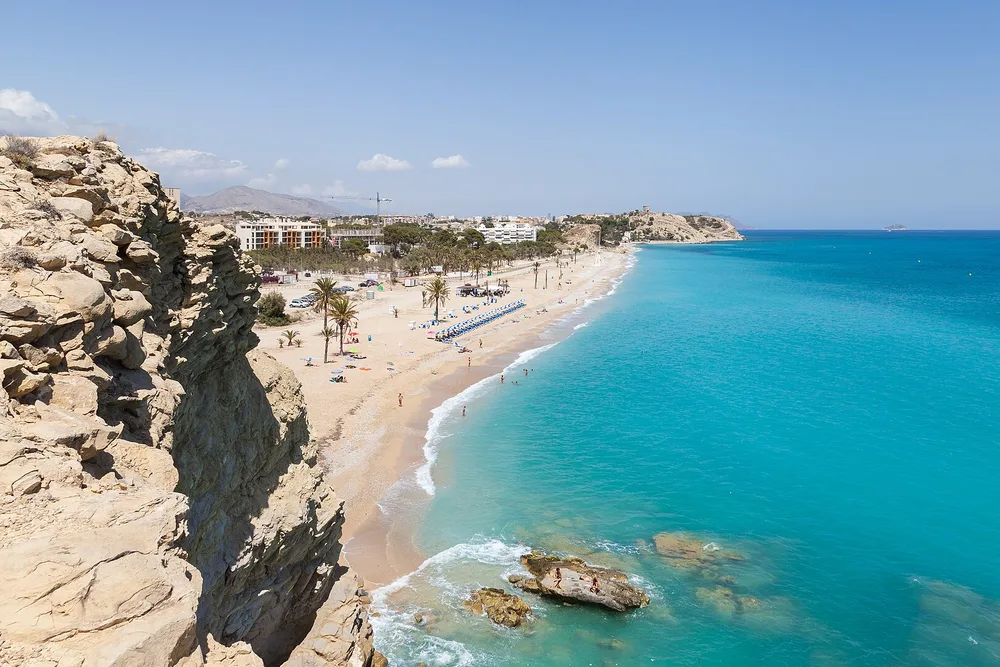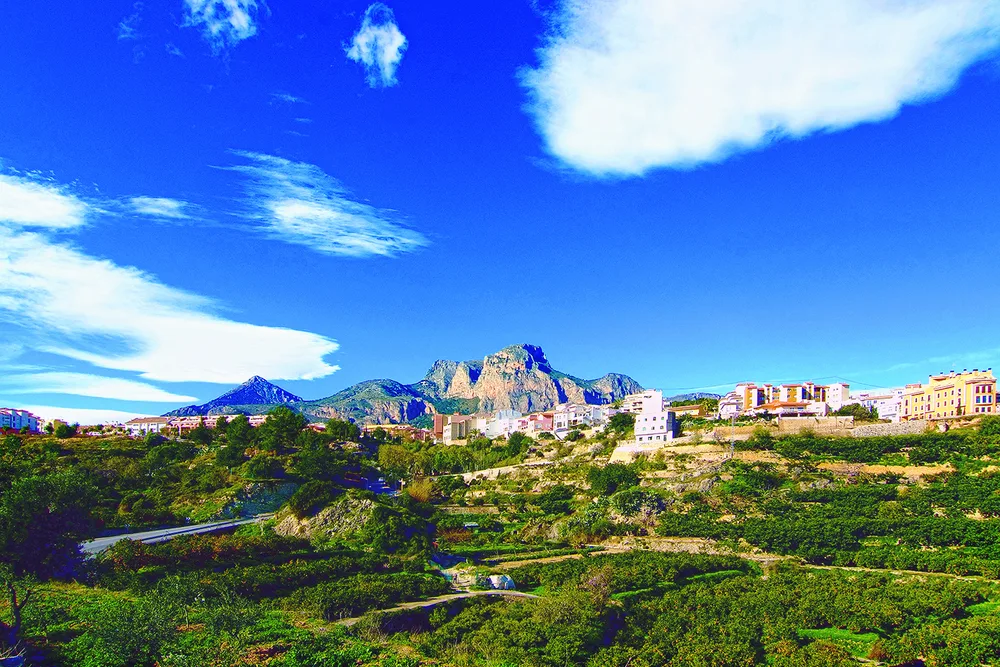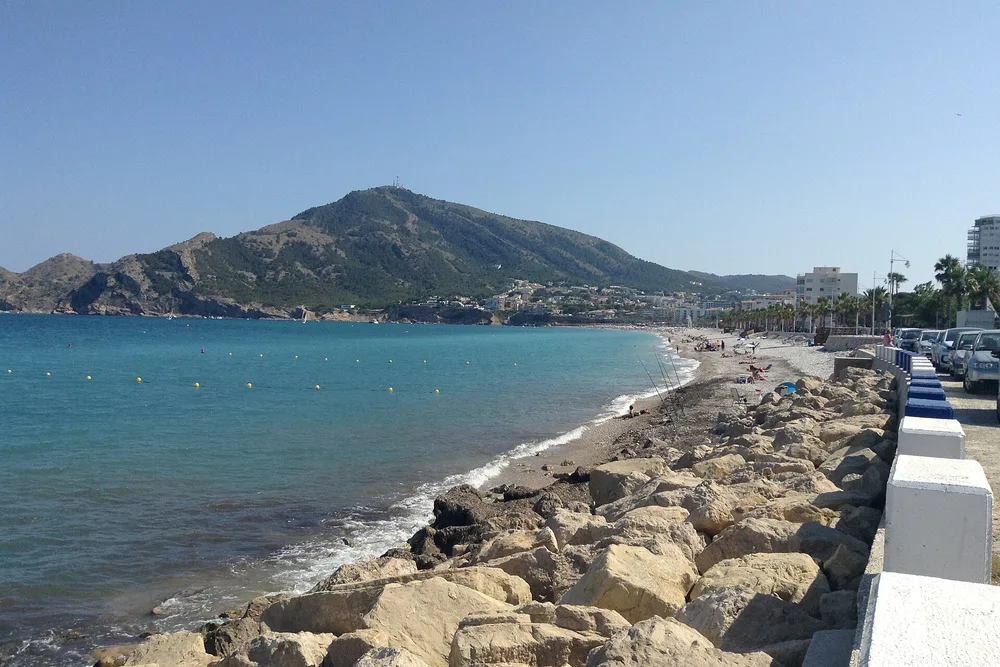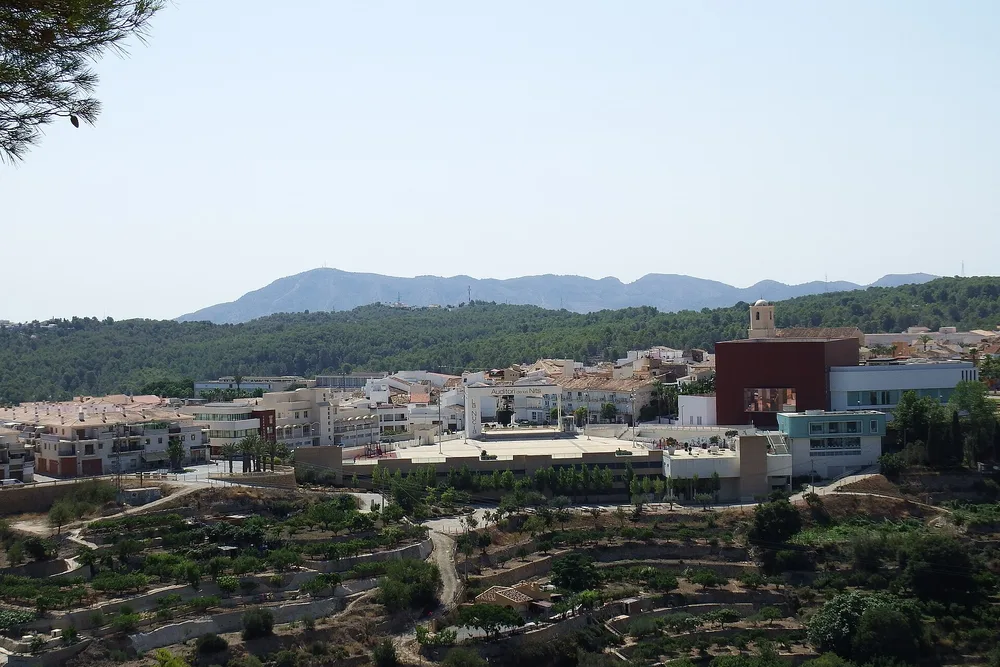
Altea
Premium, cultural and calm — the white old town, the church plaza and a slow seafront paseo set the tone.

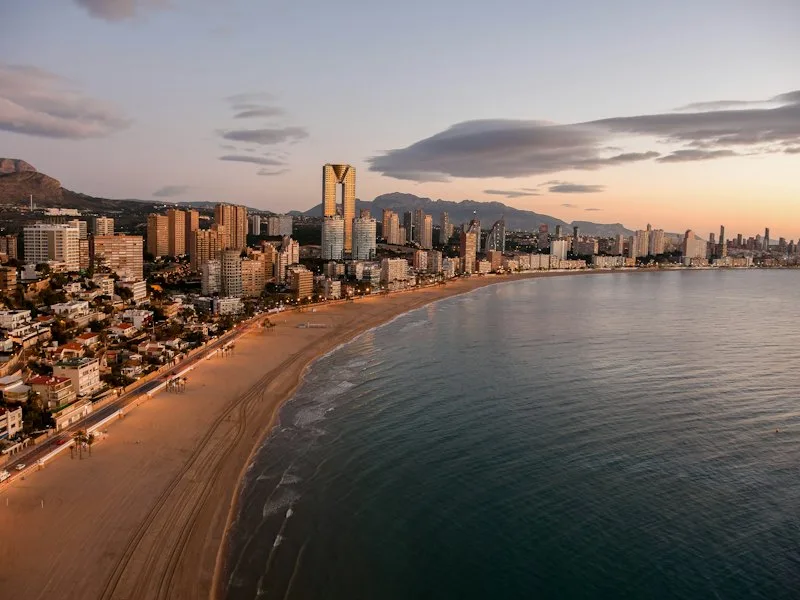
Benidorm · Area guide
A compact, vertical city between two bays — lively Levante and the quieter Poniente — with a deep apartment market, a surprising villa niche and the lowest entry band of the four screening zones.
Geographic scope
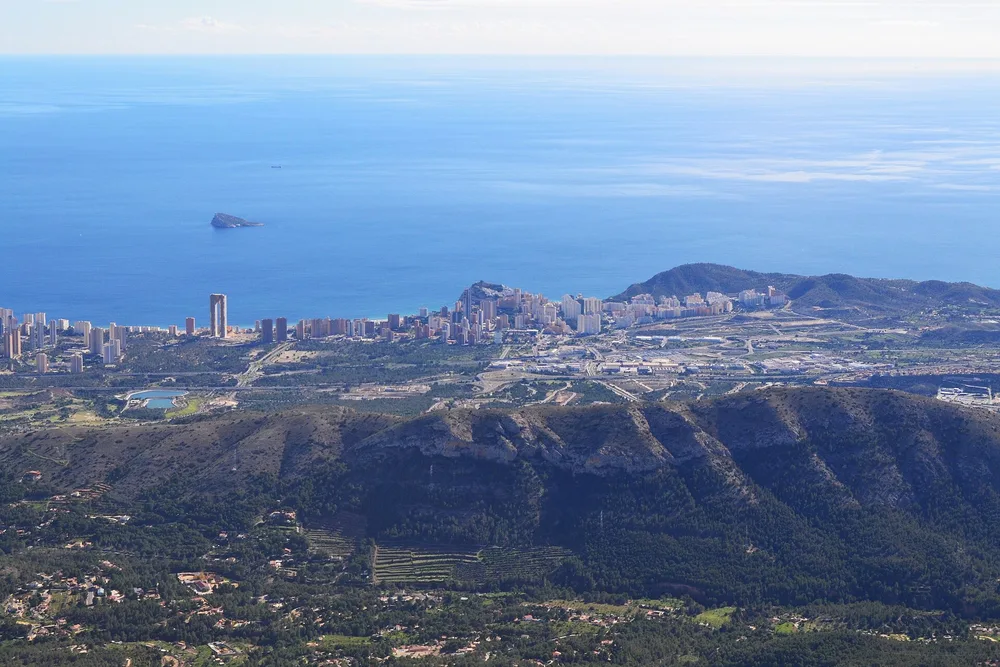
Benidorm sits on the Costa Blanca, 38 km from Alicante and 106 km from Valencia, with access via the AP-7 and N-332; Alicante-Elche airport is about 60 km away with direct bus connections. The city does not climb the hills but embraces the vertical: a compact, walkable core between lively Levante (an urban beach of ±2 km) and the quieter Poniente (±3 km), with its high-rise skyline as a signature. Behind the bays rises the protected Sierra Helada natural park, with cliffs, coves and walking routes; the TRAM leaves from Av. Beniardá station along the coast.
The layout creates four living patterns: the beach districts of Levante and Playa de Poniente, where tourism, stock and services stack up; the central area around the old town and Puerto, older and more residential; the pueblos Poniente and Levante, where the stock is calmer and more family-oriented; and the villa pockets — the Sierra Helada slopes above Rincón de Loix, the established pockets around Coblanca and Rocas Blancas, and El Planet with its larger plots. A buyer looking for a “villa in Benidorm” almost never looks at the towers; a buyer who wants the beach on foot almost never leaves the beach districts. And “Benidorm area” on a portal is not automatically the municipality of Benidorm: Sierra Cortina belongs to Finestrat, and the cadastral municipality has to be checked parcel by parcel.
Municipal profile
Verified indicators behind this guide — the asking-price index, the scale of the city and the tourism this market runs on.
All prices are asking prices, not completed transactions. The municipal average hides the spread: in August 2026, the Playa de Poniente micro area stood at €4,905/m² and Playa de Levante at €4,459/m², while the Centro Urbano district index came out at €2,868/m². Notably, that €3,807/m² sits well above the provincial benchmark of €2,759/m², yet the screening bands still place Benidorm in Zone D, the lowest of the four — compact flats and the front line drive up the price per m², while the absolute entry prices of the deep stock stay low.
Where to buy
You buy Benidorm by environment, not by municipality. Pick an environment to see what it suits, what asking prices do there and what to verify.
Front line with new towers
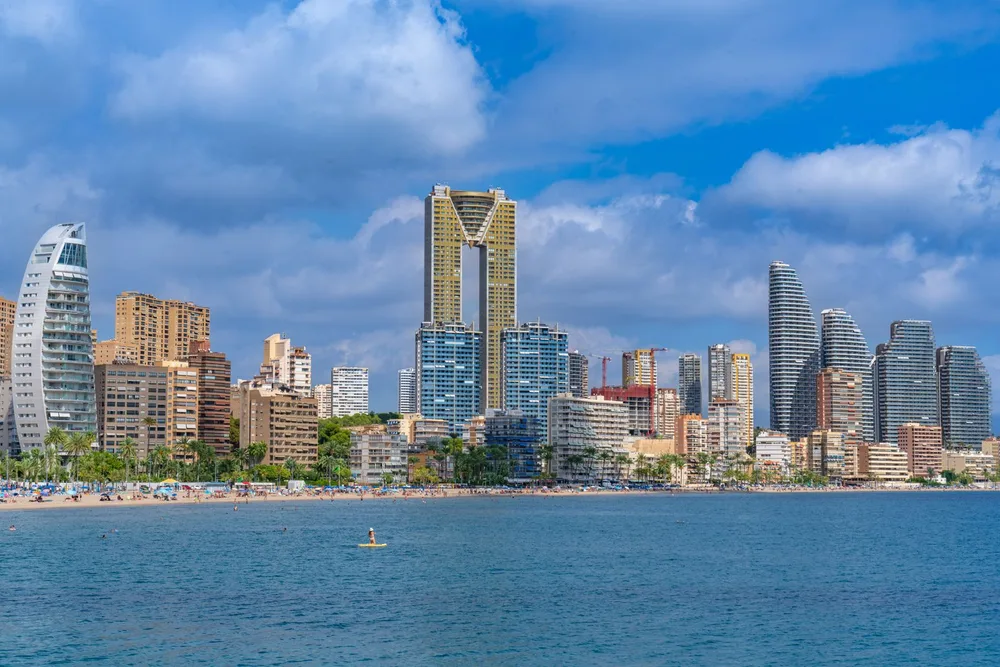
The premium seafront: a promenade of ±3 km, quieter than Levante and popular with Spanish tourists, carrying the city’s strongest new-build concentration — high-rise towers with terraces, amenities and advertised starting prices from around €600k. The underlying stock is largely 1980s; the premium pays for view, front line and novelty. Tower new build asks for attention: community charges and assessments, delivery dates and what a beach distance actually measures.
Beach life in older blocks
Classic Benidorm: an urban beach of ±2 km with promenade, restaurants and entertainment, and behind it the city’s oldest large stock layer — compact 1960s flats with 40–60 m² as the modal format. Asking prices are high for the location, not the building; the gap between a refurbished and an original flat is wide unit by unit. Lifts, façades, roofs and services are community matters with a price tag here, and noise comes with the package in the lively zones.
Slopes, coves and a villa niche
The eastern large market, in three faces: Rincón Bajo close to the beach, Rincón Alto further up the slope and the Zona Sierra Helada against the natural park, with walking routes towards Cala del Tío Ximo and Punta del Cavall. For apartments this is the touristic core layer (mostly 1980s); for villas it is the city’s clearest niche — plots with a pool, sea or mountain views and privacy, mostly resale. Slope, access and the protected edge of Sierra Helada belong in every check.
Old town and daily life
The residential heart around the old town, the harbour and central services: older urban blocks (modal 1970–1979, often 75–90 m²), more resident-facing than a resort complex, with the beach within walking distance. The district index is the city’s lowest — though the Puerto submarket lives a life of its own: a small harbour-side pocket that stood at €4,000/m² in August 2026, a figure that can move quickly in so small a market. Parking pressure, building age and the noise of city-centre life are the standing checks.
The newest residential layer
West of the seafront sits a different market than the name suggests: the district with the newest profile (modal cohort 2000–2010) and the roomiest flats (modal 75–90 m²), popular with families and year-round residents. Newer does not automatically mean seafront pricing here: the index stays well below Levante and Poniente, and the district is a residential market of its own, not a cheaper copy of the beach. The beach and promenade are a drive or a long walk away; buying here means buying comfort and build year over location premium.
The residential hinterland of Levante
The inland district east of the beach, along Avenida de Mallorca and Avenida de Europa, with urbanisations such as Coblanca and Barrina: mostly 1980s apartments a little further from the promenade — and for the villa buyer, established pockets around Coblanca and Rocas Blancas, with older, partly renovated homes close to Levante’s services. Large plots are scarce there, and that scarcity is exactly what puts a premium on privacy and parking. “Levante” in a listing does not make a home front line; the exact street counts.
Quiet, space and plots
The low-density edge of the city, where homes come on larger plots than in the beach districts — the enclave that draws villa buyers with space in mind. But the name is not a category: an official planning notice names parcels in Urbanización El Planet, which proves precisely that not every home marketed as El Planet carries the same legal or planning status. The exact parcel, municipal boundary, access and utilities are the purchase here.
Market & buyer fit
Buyers who want beach, restaurants and services within walking distance — the centre is compact and works without a car.
Second-home buyers who want a manageable lock-up-and-leave flat, with holiday letting as an option — provided the rules check out at address level.
Winter-sun buyers and retirees who want a lift, year-round services and international amenities in one city.
Families looking for a roomy apartment: Pueblo Poniente offers a modal 75–90 m² and the newest build cohorts.
Villa buyers who want plot, pool and privacy inside a major city — around Rincón de Loix, Sierra Helada and El Planet.
Buyers looking for the lowest entry band of the four screening zones without giving up city services.
Buyers seeking a quiet, rural setting far from tourism — that is not Benidorm.
Buyers counting on guaranteed rental income: occupancy figures differ by source and category and are no net yield.
Buyers who want no community rules, fees or towers — shared living in an owners’ association is the norm in Benidorm.
Buyers with a villa wish on an apartment budget: the villa entry begins where most flats stop.
Car-free buyers looking at Rincón Alto, the Zona Sierra Helada or El Planet — there, slope and car become reality.
Buyers expecting absolute quiet in the lively coastal zones — Levante is an entertainment beach and the city is working on a noise ordinance.
Snapshot
Two instruments side by side: micro-area prices where the report has rows, and the Zone D screening bands to test listings against quickly. That band is the lowest of the four — a paradox on paper, because the €3,807/m² index sits well above the provincial benchmark of €2,759/m²: compact flats and the front line drive up the price per m², while absolute entry prices stay low.
Average asking price per micro area, dearest first (Idealista asking-price report, August 2026).
Asking prices are not transaction prices: the portal index (Aug 2026) and the reported notarial transaction level (Sep 2024–Aug 2025) sit far apart and measure different things. Averages also hide the spread within a district — from compact 1960s flats to new towers.
| Property type | Band (asking prices) | Supply |
|---|---|---|
| Standard apartment | €130,000–€400,000 | — |
| Prime apartment / penthouse | €350,000–€1,300,000+ | The deepest stock in the city: resale dominates in layers from the 1960s (Levante), 1970s (Centro) and 1980s (Rincón, Poniente, Pueblo Levante), with Pueblo Poniente the newest large residential layer (2000–2010). |
| Townhouses | €220,000–€650,000 | — |
| Villa, resale | €350,000–€1,500,000+ | Scarce and fragmented in a vertical city: mostly established resale around Rincón de Loix/Sierra Helada, Coblanca and El Planet, with renovated homes the important middle segment and new build or rebuild a selective premium niche. |
| New-build apartment or villa | €300,000–€1,500,000+ | A Poniente story: high-rise towers with terraces and amenities, advertised from around €600k (Sep 2026) — no broad pipeline, with delivery dates, licences and beach distances to check project by project. |
| Building plot | €100,000–€550,000+ | — |
Screening bands (Sep 2026) exist to test listings quickly — they are not an appraisal. The exact location, legal floor area, condition and access can put a specific home well above or below its band.
Local conditions
Three conditions decide what you actually buy in Benidorm: the coast and the scale of the city, access and year-round life, and a rental regime that is still moving.
Levante is an urban beach of ±2 km with a lively promenade, restaurants and entertainment; Poniente measures ±3 km, is quieter and especially popular with Spanish tourists. The centre between them is compact and largely car-free — though the experience changes by district: Rincón Alto and the Sierra Helada side have slopes, and the walking route towards Cala del Tío Ximo and Punta del Cavall is an outing, not an everyday stroll. Tossal de la Cala, an archaeological hill of ±100 m near La Cala, gives the western side its own character and its own planning check.
Benidorm sits 38 km from Alicante and 106 km from Valencia, with the AP-7 and N-332 as motorway and coastal routes; Alicante-Elche airport is ±60 km away with direct bus lines, the TRAM leaves from Av. Beniardá and the Paseo Els Tolls bus station gathers regional services. The city counts 77,221 registered residents and a tourism economy with year-round ambition: ±3.1m travellers and 16.2m overnight stays in 2025. Services, healthcare, supermarkets and restaurants keep running out of season — still, test them in winter where you intend to live.
Tourist letting is a complete dwelling ceded to the same tenant for 10 days or fewer; 11 days or more falls outside the VUT definition. Benidorm screens through a municipal compatibility report under Interpretation No. 9 of the PGMO (adopted 27 October 2025); the Valencian registration runs five years and a change of ownership restarts the process. Since 3 April 2025 (Ley Orgánica 1/2025), prior community approval is required — three-fifths of owners and quotas, with a surcharge of up to 20% possible — and the first fines followed in 2026. The legal position still moves: in May 2026 the Spanish Supreme Court annulled the national short-stay register on competence grounds, without the Valencian and municipal checks falling away — verify the current position before you buy.
Buyer issues
These issues recur in Benidorm — each can be checked at address level before signing, not after.
The asking-price index (Aug 2026: €3,807/m²) and the reported notarial transaction level (Sep 2024–Aug 2025: €2,882/m², an average of €215,271 across 2,229 sales) measure different things and sit far apart. Compare like-for-like sales, request a current valuation and keep asking and transaction evidence separate.
Lifts, façades, roofs, waterproofing, pools and accessibility run through the owners’ association — in older Levante and Centro blocks as much as in high-rise towers. Read three years of minutes, reserve funds, planned special assessments (derramas) and the community debt certificate before you make an offer.
Glazed balconies and terraces, storage rooms, parking spaces, underbuilds and later alterations do not appear one-to-one in the title deed, Cadastre and floor plan. This affects price comparison, finance, insurance and tourist registration — measure and reconcile before you do the numbers.
The VUT definition covers a complete dwelling for 10 days or fewer; letting separate rooms falls outside it. A favourable compatibility report is required, a five-year registration with renewal, and — for starting the activity in a community building — prior approval by three-fifths of owners and quotas. A previous registration or an advert saying “licence included” proves nothing for a new owner; Benidorm issued its first fines in 2026.
Portal groupings pull Finestrat (including Sierra Cortina), La Nucía, l’Alfàs del Pi and Villajoyosa into the Benidorm search area. The cadastral municipality decides taxes, planning, tourist registration and services — verify the 20-character cadastral reference before you compare prices or rules.
The city reported 77.7% occupancy for tourist apartments and 51.3% for tourist homes in 2024; Hosbec put tourist homes at about 41% average occupancy in early 2026, 4.9 nights per stay and €194 per night. Different years, sources and categories — and none of them is a net yield. Ask for booking history, net statements and proof of legal operation.
Hillside homes bring retaining walls, drainage, waterproofing and access roads with them; the protected Sierra Helada natural park limits assumptions about views and gardens. Have the flood-risk map (PATRICOVA) reviewed for ravines, low points and marketed underbuilds, and test the Sierra Helada road project against the parcel’s access.
Our advice
Do not buy on the “Benidorm” label: Sierra Cortina belongs to Finestrat and portals group neighbouring municipalities in — verify the cadastral reference.
Do not take the asking-price index as a transaction level: ask for recent, comparable sales and keep asking and transaction evidence apart.
Do not count on tourist letting without an address-level check: the compatibility report, the registration and community approval decide.
Do not take “renovated” at face value: invoices, permits and the state of the building itself decide what the renovation is worth.
Do not underestimate community charges in towers and older blocks: lifts, façades and roofs run through the association — read three years of minutes.
Frequently asked questions
The questions Dutch buyers ask us about Benidorm — with the short, verifiable version of each answer.
On the map
Benidorm lies on the Costa Blanca in the province of Alicante, beside the bays of Levante and Poniente.
Browse by location
Each area has its own buyer logic: character, housing stock and entry prices differ.
Premium, cultural and calm — the white old town, the church plaza and a slow seafront paseo set the tone.
Beach, family and rental appeal — with real seasonality to plan around.
Coast, village and privacy — villa country between Calpe and Moraira.
Authentic and emerging — colourful seaside town, lower entry prices.
Residential, sport and family — inland of Altea, good value and facilities.
International, healthcare and permanent living — strong year-round community.
Inland village with mountain views — more house for the budget, a short drive to the coast.
Quiet coastal living between Moraira and Javea, with dramatic clifftop spots.
Premium and varied — port, old town and beach each with their own character.
Port town at the north end of the Costa Blanca, with ferry links and a real working feel.
To the listings
Benidorm is the apartment capital of the coast, and its two bays are not priced alike: Levante and Poniente each carry their own level. Compare them in figures — per property type, with the bands every listing can be tested against — before you pick a side.
Area guide
The buyer’s guide, market data for all areas on the Costa Blanca North, the mortgage calculator and answers to common questions — everything you need to prepare your purchase, in one place.

The buying process step by step: offer, contract, taxes and due diligence.

Asking prices, trends and screening bands per town — the full market picture across the thirteen towns.

More answers about buying, taxes and ownership on the Costa Blanca.
Estimate your monthly mortgage costs before you shortlist.
Looking for a property on the Costa Blanca? Tell us what you’re looking for, and our team will get back to you shortly.